
Anyang 6-Day Tour: Laojun Mountain & Longmen Grottoes
Anyang 6-day tour covering Laojun Mountain and Longmen Grottoes and Erlitou Site. Sightseeing tickets and shuttle bus included.
Highlights
Day 1: Laojun Mountain
Gather in the morning and depart for Laojun Mountain, follow the tour guide to visit the main attractions, leaving ample time for taking photos and resting; enjoy a local specialty meal at noon, and check into the hotel in the evening to recharge for the next day's itinerary.
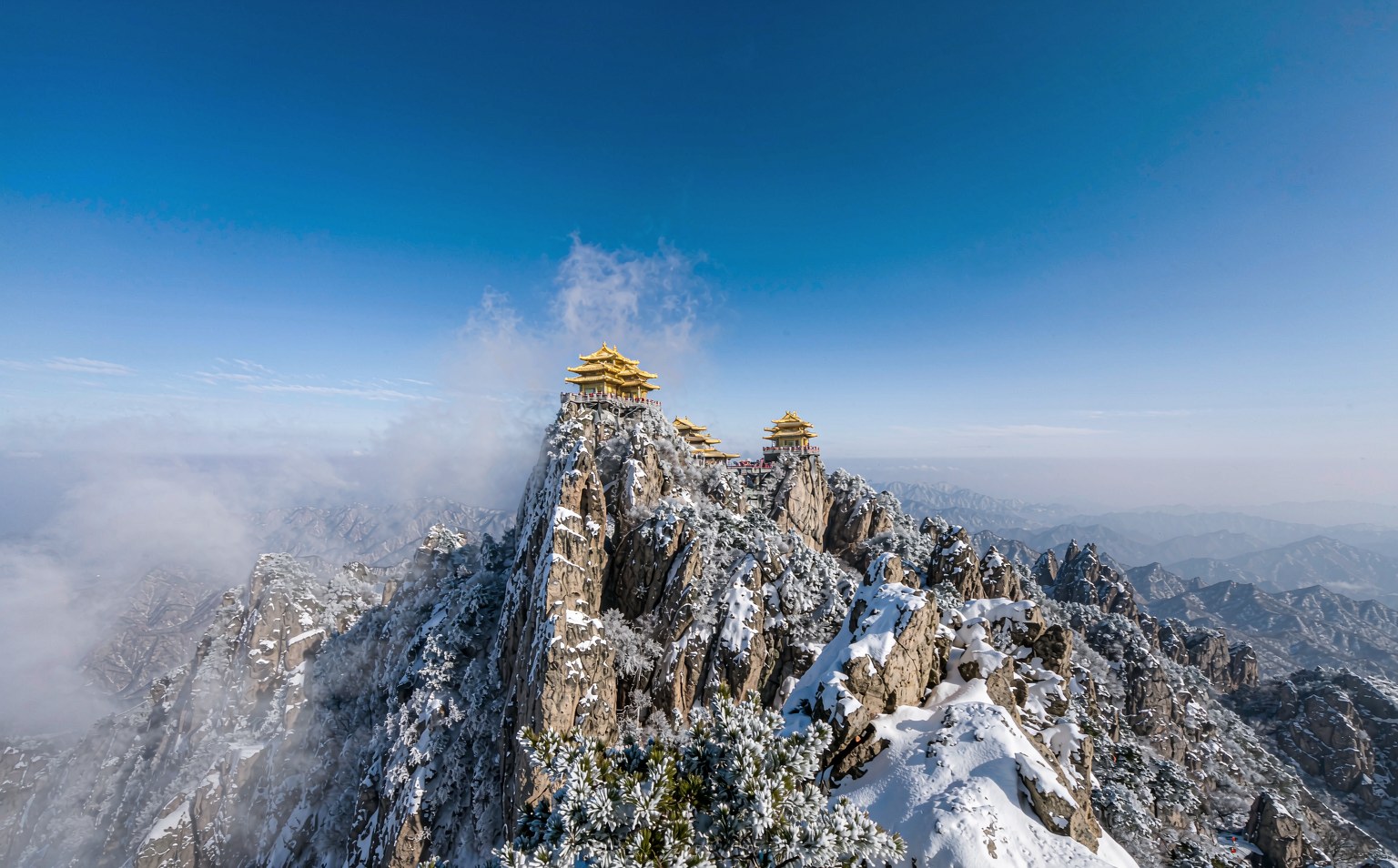
Attraction Introduction: Today's itinerary includes the Laojun Mountain attraction, Laojun Mountain is located in Luoyang Luanchuan County, and is the main peak of the Funiu Mountains as well as a famous Taoist mountain. It is said to be the place where the Taoist ancestor Laozi retreated for cultivation. The Golden Summit Taoist Temple complex stands on a peak over two thousand meters above sea level, with golden tiles and red walls, surrounded by a sea of clouds, earning the reputation of "a dazzling feast in the mortal world, a glimpse of the splendor of the human world." The Ten-Mile Painted Screen is the highlight of the entire journey—a high-altitude walkway suspended on a cliff that changes scenery step by step, offering a full view of the peak forest, sea of clouds, and sunrise. You can take a two-stage cable car to ascend; on clear days, you can watch the sunrise over the sea of clouds from the top, and in winter, it is a highly popular spot for snow viewing in the Central Plains. My understanding is that you must take the cable car early to get the best light for the Golden Summit and Ten-Mile Painted Screen; the top is windy and cold, so a windbreaker and thermos are essential, and those afraid of heights should not force themselves on the glass viewing platform.
Tips: The mountain path is slippery in many places, especially going downhill, pay attention to shifting your center of gravity backward and slow your pace; knee pads are recommended. Visitors generally agree that the Golden Summit sea of clouds and sunrise are the main highlights, and many people stay on the mountaintop to await dawn. Note that there is a large temperature difference on the mountaintop and queues for the cable car can be long, so be sure to go early during peak season. Depending on the situation, to get good photos, go early or late—the morning has fewer people and soft light, the evening has golden light for the best shots, while the noon light is harsh and crowded; at that time, rest is a better option.
Day 2: Longmen Grottoes
Gather in the morning and depart for Longmen Grottoes, follow the tour guide to visit the main attractions, and allow ample time for taking photos and resting; have a local specialty lunch at noon, check into the hotel in the evening, and recharge for the next day's itinerary.
Attraction Introduction: Today's itinerary includes Longmen Grottoes attractions. Longmen Grottoes was carved on the cliff walls along both sides of the Yi River in the southern part of Luoyang city. Construction continued from the time Emperor Xiaowen of the Northern Wei moved the capital to Luoyang and spanned multiple dynasties including the Eastern Wei, Western Wei, Northern Qi, Sui, and Tang. Currently, there are more than 2,300 niches, over 100,000 statues, and more than 2,800 engraved epitaphs. The most stunning is the Leshan Giant Buddha in the Fengxian Temple, which is over 17 meters tall, with a plump face and compassionate eyes, and is said to have been carved in the likeness of Empress Wu Zetian. It represents the pinnacle of stone carving art in the Tang Dynasty. Along with Dunhuang Mogao Caves and Datong Yungang, it is known as one of China's three major grottoes and is also a World Cultural Heritage site. During the visit, start from the West Mountain Grottoes along the Yi River walkway heading south; Binyang Three Caves, Wanfo Cave, and Lotus Cave each have interesting features. After crossing the bridge to the East Mountain Worship Terrace, you can overlook the full panorama. My suggestion is to first visit the main caves in West Mountain in the morning to enjoy the Giant Buddha with fewer crowds, and in the afternoon go to the East Mountain to view the scenery from afar, where the lighting and angles are best for photos; walking along both banks of the Yi River involves some backtracking, so a pair of comfortable shoes will save a lot of effort.
Warm Tips: Visiting the grottoes mainly involves walking and stairs, so it is recommended to wear non-slip, comfortable shoes and carry light luggage. Pay attention to your footing along both banks of the Yi River. Most tourists have remarked that the Leshan Giant Buddha is the most impressive, and the sunset at West Mountain provides the best lighting for photos; walking along both banks of the Yi River involves backtracking, so comfortable shoes and reserving half a day are recommended. Considering practical situations, during long trips dehydration is the biggest concern, so carry a water bottle and drink frequently in small amounts; when arriving at highlands or mountainous areas, avoid washing your hair or taking long showers on the first night to allow your body some adjustment time.
Day 3: Erlitou
Gather in the morning and set off for Erlitou, follow the guide to visit the main attractions, allowing plenty of time for photos and rest; enjoy a local specialty meal at noon, check into the hotel in the evening, and recharge for the next day's itinerary.
Attraction Introduction: A highlight of the itinerary is Erlitou. The Erlitou ruins are located in Yanshi, Luoyang, and are regarded by scholars as the "earliest China." It is a large city site from the mid-to-late Xia Dynasty. Excavated artifacts include turquoise dragon-shaped objects, bronze jue, bronze ding, and other significant items, revealing the appearance of the first royal capital of China. The turquoise dragon-shaped object is inlaid with more than two thousand pieces of turquoise and is hailed as the "First Dragon of China," providing important evidence of dragon worship in China. The Erlitou ruins museum presents an archaeological on-site experience and is an unavoidable stop for studying the origins of Chinese civilization. My understanding is that visiting the site with prior knowledge of the academic controversies surrounding the "Xia capital" allows for a deeper appreciation of the exhibits; the museum's display is carefully curated and worth exploring slowly.
Tips: There is a large temperature difference between day and night in the mountains, and the wind on the mountaintop is strong, so a windproof jacket and warm inner layers are essential. General feedback from tourists indicates that most consider Erlitou worth a special visit. It is recommended to slow down, follow the guide's explanations, and leave time for the details that move you most and the best photo spots. Considering the actual situation, be punctual; arrive five to ten minutes early for gatherings—better for people to wait for the vehicle than for the vehicle to wait for the person, so as not to make everyone wait for you.
Related Tours
Anyang 4-Day Tour: Scenic Area
Anyang 4-day tour covering Scenic Area. Sightseeing tickets and shuttle bus included.
Zhengzhou 5-Day Tour: Longmen Grottoes & White Horse Temple
Zhengzhou 5-day tour covering Longmen Grottoes and White Horse Temple and Laojun Mountain. Sightseeing tickets and shuttle bus included.
Luoyang 3-Day Tour: Luoyi Ancient City & Shaolin Temple
Luoyang 3-day tour covering Luoyi Ancient City and Shaolin Temple. Sightseeing tickets and shuttle bus included.
Luoyang 3-Day Tour: Longmen Grottoes & White Horse Temple
Luoyang 3-day tour covering Longmen Grottoes and White Horse Temple and Wangcheng Park. Sightseeing tickets and shuttle bus included.